
 By
By How to test your Internet speed properly
Testing your internet speed is quick and easy, but doing it properly is what gives you useful, reliable results. Follow these simple steps before you hit Start:
Use one device only
Pause all downloads, streams, cloud backups and updates.
Restart your modem/router
If it has been on for weeks without a break.
Sit close to your WiFi router
Or, even better, plug in with an Ethernet cable.
Close unnecessary apps and tabs
Make sure your browser is up to date.
Run the test 2–3 times
Note the average download, upload and ping.
For better results, compare a WiFi speed test with a wired broadband speed test. If wired is much faster, your ISP is fine, your WiFi setup is the issue.
Understanding your Internet speed test results
Your results screen can look a bit technical, but each number simply tells you how smooth your online life will be. Download speed drives streaming and browsing, upload speed powers video calls and file sharing, while ping and jitter decide how "laggy" everything feels in real time.
Fibre broadband should deliver much higher and more stable speeds than ADSL, especially if several people are online at the same time. Use the reference values below to see whether your current connection is doing a good job or holding you back.
| Metric | What is it? | Fibre reference values | ADSL reference values |
|---|---|---|---|
| Download speed (Mbps) | How fast you receive data (streaming, browsing, downloads) | 2-8 Gbps | 8-20 Mbps |
| Upload speed (Mbps) | How fast you send data (video calls, file uploads, cloud backups) | 1-8 Gbps | 0.5-1 Mbps |
| Ping / Latency (ms) | How long it takes data to travel back and forth, crucial for gaming and video calls | <20–30 ms | 40-80 ms |
| Jitter (ms) | How much your ping varies over time; high jitter causes choppy sound and video | <20-30 ms | 30-40 ms |
Updated in April 2026
What is a good Internet speed in France in 2026?
In France in 2026, a good fibre internet speed usually means somewhere between 450 and over 600 Mbps download, which is now the reality for many households thanks to massive FTTH rollout. That's why this section focuses on fibre, the most widely used and future‑proof fixed technology in the country.
To see if your speed is good for your lifestyle, use these simple benchmarks:
Single person or couple, student, streaming HD, browsing, a few video calls: anything from 1 Gbps upwards is already very comfortable.
Power users (home office with big file transfers, multiple gamers, many connected devices): a 8 Gbps fibre plan gives you extra headroom and stability.
If your speed test shows much less than what your fibre plan advertises, or you are stuck on ADSL below 30 Mbps, it's a clear signal it's time to upgrade your offer or switch Internet provider in France.
Why your broadband speed test is slower than expected
A broadband speed test that looks slow doesn't always mean your provider is scamming you. In most cases, something in your home setup or on the network is quietly eating away at your bandwidth.
The most common culprits are:
Outdated or overloaded equipment
Old routers, weak WiFi, bad Ethernet cables or boxes that haven't been restarted for weeks.
Too many devices at the same time
Streaming, gaming, video calls and smart home devices all competing on the same connection.
WiFi issues
Distance from the box, thick walls, interference from neighbours' networks or staying stuck on a crowded 2.4 GHz band.
Network congestion or throttling
Speeds dropping at peak hours because everyone is online, or temporary slowdowns applied to heavy users.
Access technology and line quality
ADSL lines far from the exchange, or mixed fibre/copper (FTTC) links, will never match full FTTH performance.
How to Improve a slow Internet connection
Quick fixes you can try now to boost your Internet speed
Before you change provider, try a few quick wins that often boost a slow connection in minutes.
Restart your modem/router
Unplug it for 30 seconds, then plug back in to clear glitches and refresh the signal.
Move your router
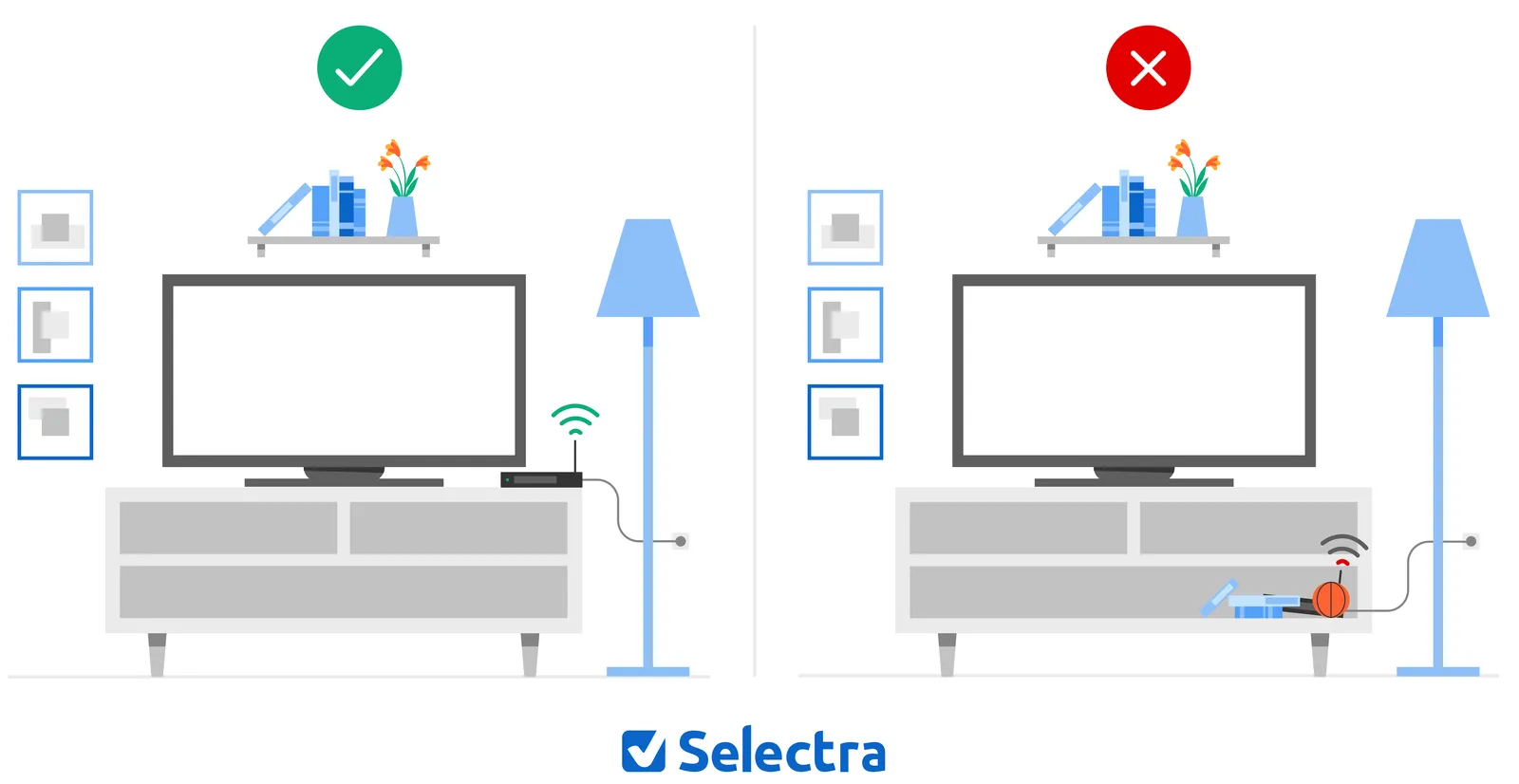
Central, elevated, open spot — not in a cupboard, not on the floor, away from microwaves or thick walls.
Disconnect unused devices
Old phones, smart TVs, consoles stop silently consuming bandwidth in the background.
Use an Ethernet cable
For your main PC, TV or console to get a faster and more stable connection than WiFi.
Switch to 5 GHz WiFi
For nearby devices to gain speed and reduce interference; keep 2.4 GHz for rooms further away.
When to upgrade your broadband plan or switch providers in France
If your internet still crawls after basic WiFi fixes, it's probably not you: it's your plan or provider. In fibre‑covered France, where over 90% of premises can now get FTTH, staying on an old or underpowered offer makes less and less sense.
You should seriously consider upgrading or cancelling your current broadband plan, or even switching provider when:
Your speed test regularly shows much lower speeds than those advertised in your contract, even on a wired connection and outside peak hours.
Streaming, video calls or cloud tools freeze as soon as several people are online, a clear sign your bandwidth no longer matches your household's usage.
You are still on ADSL or VDSL in an area where fibre is available on your line, which now covers the vast majority of homes in France.
Your provider cannot offer higher speeds, better WiFi equipment or a more recent Internet box without extra fees that are out of line with the market.
In all these cases, checking current fibre deals and potentially switching providers in France is often the fastest way to actually feel a before/after difference.
Most operators will refund up to €100 or even €150 of the termination fees when you switch providers!
Which provider offers the fastest Internet speeds?
According to the nPerf 2025 barometer of fixed connections in France (2025 data published on 12 January 2026), Bouygues Telecom confirms its position as market leader, with the best overall score and a particularly consistent user experience, supported by very high speeds, low latency, and excellent performance in both browsing and streaming.
Orange secures a strong second place, driven by high average speeds and very reliable overall service quality across all fixed uses. Free remains a very aggressive competitor, especially on downstream and upstream speeds, but its overall score is still slightly behind Bouygues Telecom and Orange, which indicates a user experience that is somewhat less polished according to nPerf.
SFR, finally, comes last with more modest performance, particularly in terms of speeds and latency, even though the operator also benefits from the overall improvement trend of fixed connections in 2025.
 #1
#1
 #2
#2
 #3
#3
 #4
#4
| Indicator | |
|
|
|
|---|---|---|---|---|
| Download Speed | 425.21 Mb/s | 339.83 Mb/s | 491.07 Mb/s | 451.20 Mb/s |
| Upload Speed | 325.03 Mb/s | 267.28 Mb/s | 371.43 Mb/s | 325.61 Mb/s |
| Latency | 14.55 ms | 15.34 ms | 12.31 ms | 15.54 ms |
| Web Browsing | 86.60 % | 83.61 % | 87.03 % | 85.92 % |
| Video Streaming | 87.65 % | 86.42 % | 88.00 % | 86.42 % |
| Overall Score | 156650 | 147909 | 162106 | 154936 |
Source: nPerf Barometer - 2026.
Learn more about our scoring methodology
Your review helps others choose — it takes 2 minutes.
Click a star to get started.
Rate your provider
Only verified reviews are published
Thank you for your review!
A verification link has been sent to your email address. Click it to publish your review. It only takes a few minutes.